
'We've moved from thousands killed yearly in Jammu and Kashmir to 127 last year.' 'Cross-border terrorism in Kashmir is being solved. We are winning it.'

The 70-year-old real estate tycoon had last month described tensions between India and Pakistan as a "very, very hot tinderbox" and offered to be "the mediator or arbitrator" if it was necessary and if the two countries wanted him to, following which the Foreign Office had welcomed such an offer.

External Affairs Minister S Jaishankar addresses Parliament on Operation Sindoor, denying any US trade linkage and highlighting Pakistan's request for a ceasefire through the DGMO channel.
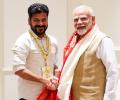
Reddy alleged that contracts worth thousands of crores were awarded to people close to Modi, who then purchased Rafale aircraft.
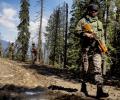
Pakistan has warned the international community that any military moves by India shall be 'responded to assuredly and decisively... onus of any escalatory spiral and its consequences shall squarely lie with India.' Implicit in the statement is a veiled threat that even a nuclear threshold may be reached if push comes to shove, warns Ambassador M K Bhadrakumar.
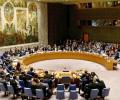
The United Nations Security Council held closed-door consultations on rising tensions between India and Pakistan, with envoys calling for restraint and dialogue. The consultations, requested by Pakistan, lasted for about an hour and a half. UN Secretary-General Antonio Guterres expressed concern over the tensions, urging both countries to avoid a military confrontation. India's former Permanent Representative to the UN, Syed Akbaruddin, said that no consequential outcome could be expected from the discussion.
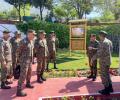
'Surgical strikes or air strikes, or both, are likely on the table.'
For Ali, who hails from Mendhar sub-division near the Line of Control (LoC) in Poonch district, the uniform is more than a job -- it's a calling. He has dedicated nearly half his life in the police force, serving its various wings with distinction and earning multiple commendations for his courage and unwavering commitment to duty.

A police officer and his eight siblings, including five sisters, were deported to Pakistan on Wednesday despite a court order granting them temporary relief. The nine members of the extended family, who have been living in Jammu and Kashmir for generations, were among more than two dozen people, mostly from Pakistan-occupied Kashmir (PoK), who were served deportation notices following the April 22 Pahalgam terror attack. The deportation has sparked outrage, with protests and appeals for intervention from the home minister and lieutenant governor. The family members claim they are not Pakistani nationals and have been living in the region for generations, presenting revenue records to support their claims. The court has ordered a detailed report on the case within two weeks and will hear it again on May 20.

Asserting that India will not tolerate any 'nuclear blackmail', Prime Minister Narendra Modi on Monday said operations against Pakistan have only been kept in abeyance and the future will depend on their behaviour.

He, however, said sometimes such people spread wrong news or information about China on purpose.
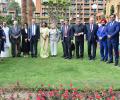
All-party parliamentary delegations on Monday met with the leaders of several countries and highlighted India's resolve to combat terrorism, which they stressed must be eradicated in the interests of all humanity.

The Congress on Monday distanced itself from the controversial comments of some of its leaders on the Pahalgam terror attack, saying that only the recent CWC resolution and the views expressed by AICC chief Mallikarjun Kharge, Rahul Gandhi and authorised AICC office-bearers represent its position. The opposition party's assertion comes in the wake of remarks by leaders like Vijay Wadettiwar, Mani Shankar Aiyar, Shashi Tharoor, Tariq Hameed Karra and Saifuddin Soz that have triggered a row, with the BJP alleging that some from the opposition party were speaking "Pakistan's language".
'It was inspired by the Hamas attack and was like their attack -- well planned and well executed.'
India needs to be technologically and militarily prepared to defend itself from both Pakistan and China, alerts Ramesh Menon.

It will be for the first time in nearly nine years India's external affairs minister will travel to Pakistan even as the ties between the two neighbours remained frosty over the Kashmir issue and cross-border terrorism emanating from Pakistan.

'The Pakistanis called the US state department and said we agree with India on peace.' 'It was then that US President Donald Trump jumped in and took credit for the ceasefire.'
'India today feels enough is enough and we need to teach Pakistan a lesson.' 'Unless compelled, Mr Modi will think 10 times before taking the extreme step.'
'It could be the Pakistan army's commercial interest, tactical or strategic interest or one of their leaders.' 'Even if you send a message that we have attempted to kill one of the Pakistani generals, that itself will serve the purpose.'

'War is not an answer. War is not a solution.' 'Deterrence is a solution. We should have the stick with us with which we can beat Pakistan.'
'He is intrigued by the intractability of Kashmir issue. With his interest in dealmaking and peacebrokering, he sees it as an exciting challenge to tackle.'
'Right now, we have no relationship with Pakistan. And the relationship with China is not great.'

US Secretary of State John Kerry has had "two conversations" over the "last two days" with External Affairs Minister Sushma Swaraj on this issue, even as India explores a range of diplomatic options to isolate Islamabad.

Pakistan on Monday termed as "irrational" India's strong reaction to a court's ruling ordering release of 2008 Mumbai terror attack mastermind Zaki-ur-Rehman Lakhvi, but hoped that the issue will not affect the proposed bilateral talks.
Thursday's judgement implies that the 2004 Act was not in consonance with the apex court judgement of 2003 which had mandated the construction of the SYL canal that has been stalled.
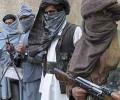
The National Assembly Standing Committee on Foreign Affairs on Monday issued a four-page policy paper linked to Kashmir.

Pakistan Prime Minister Nawaz Sharif riefs Opposition on LoC after India's surgical strikes

Industry bodies said India's move to grant the status to Pakistan had not made much of a difference as it was not reciprocated

Amid growing strain in India-Pakistan ties, the government is planning to fast-track four projects in Indus river basin to increase irrigation area in Jammu and Kashmir by nearly 2.05 lakh acres, weeks after India decided to "exploit to the maximum" the water of Pakistan-controlled rivers, including Jhelum, as per Indus Water Treaty.

Pakistan on Wednesday said it was "encouraged" after BJP's Prime Ministerial candidate Narendra Modi's remarks regarding ties with foreign countries and asserted that it was looking forward to a stable government here to engage "quickly, comprehensively and meaningfully".


India has rejected any third party intervention in the Kashmir issue and has maintained that all outstanding matters in Indo-Pak ties should be resolved bilaterally.
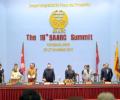
Apart from India, Bangladesh and Bhutan have also pulled out of the SAARC Summit in Islamabad in November, saying the environment is not right for the successful holding of the meet.

India's failure to resolve the Kashmir issue and improve relationship with Pakistan has been an "impediment" to India's rise and become the greatest hurdle in it becoming a permanent member of the UN Security Council and the Nuclear Suppliers Group, Pakistan Prime Minister Nawaz Sharif's envoys have claimed.

'The Pakistanis were lulled adequately to provide one of the fundamental prerequisites for successful execution of such an option: Surprise.' 'The other requisite: Deception in terms of selection of areas for launch/time of offensive action,' explains Brigadier S K Chatterji (retd).

If the (Pakistani) military continues to send arms and fighters across the border, the Indian PM will have a strong justification to take action, says The Wall Street Journal.
The meeting comes as India continues its attempts to isolate Pakistan in the South Asian region after the attack on its army camp in Uri.

Underlining that cross border attacks have greatly "diminished" Pakistan's international standing, an American think-tank expert has said that as a result of India's new policy of retaliation Pakistan is in a bind of "its own making".

Swaraj also said that Pak cannot take Kashmir to the ICJ.
